OEM & Custom Solutions
How to Customize Dry Bags With Your Logo | CarryEase
Learn how to customize dry bags with your logo. Compare printing methods, explore logo placement, and discover key considerations for OEM waterproof bag orders.
How to Customize Dry Bags With Your Logo: A Guide for Brands
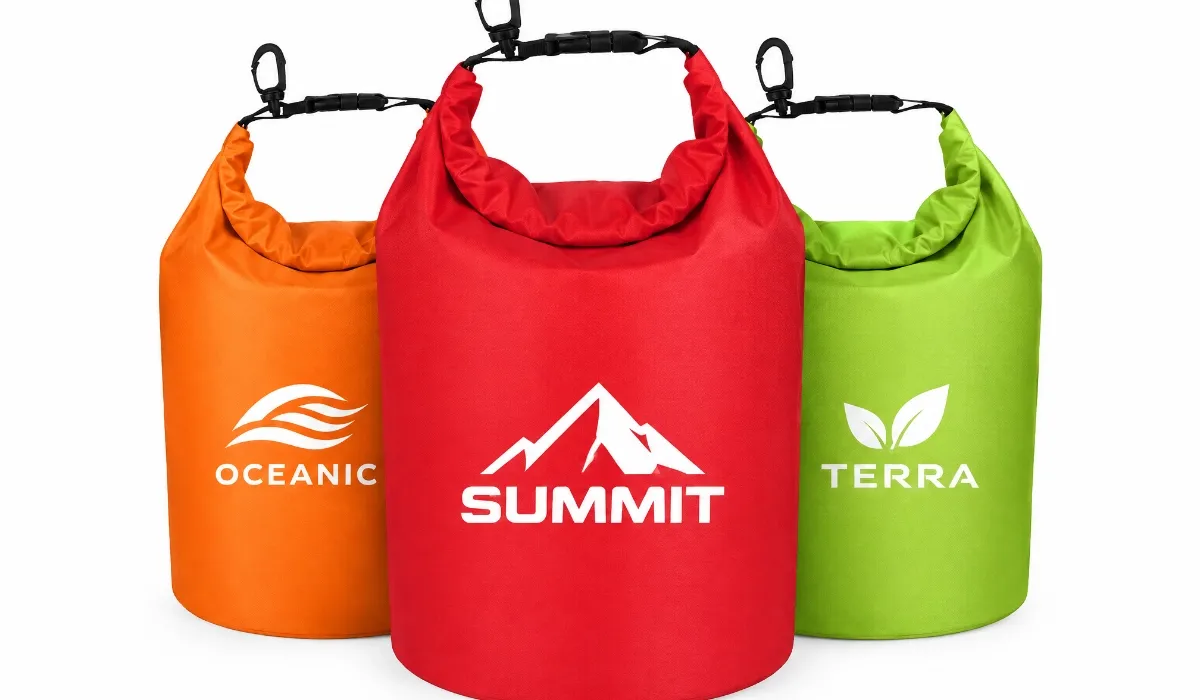
Custom dry bags with your logo help outdoor brands, water sports retailers, tour operators, and promotional product suppliers create practical products that customers can use on the water and outdoors.
Whether you are developing branded dry bags for retail, supplying equipment for kayaking tours, or creating promotional products for an outdoor campaign, the right customization choices can make a difference in product appearance, functionality, and cost.
As an OEM/ODM waterproof bag supplier, CarryEase helps businesses explore different bag styles, materials, logo applications, and packaging options for their projects.
In this guide, we explain how to choose the right logo printing method, prepare your artwork, and plan a custom dry bag order.
1. Choose the Right Dry Bag Style and Material
Before deciding how to print your logo, consider how the bag will be used and which material best suits your product requirements.
Choose a Bag Style for Your Market
Different customers need different dry bag designs.
- Roll-top dry bags: A versatile option for kayaking, boating, camping, and general water sports.
- Waterproof dry backpacks: Suitable for hiking, paddling, and outdoor activities where hands-free carrying is important.
- Waterproof duffel bags: Useful for carrying larger amounts of clothing and equipment.
- Lightweight dry bags: Practical for travel, backpacking, and customers who prioritize low weight.
- Specialized waterproof gear bags: Designed for applications such as diving, canyoning, and other water sports.
Capacity should match the intended use. Smaller bags may suit phones, valuables, and personal essentials, while larger bags can accommodate clothing and outdoor equipment.
Select a Suitable Material
PVC tarpaulin and TPU are two material options commonly considered for waterproof bags.
PVC tarpaulin is often selected for its durability and suitability for many general-purpose waterproof bag applications. TPU may be preferred when flexibility, weight, or specific material requirements are important.
The best option depends on your target market, product specifications, budget, and performance expectations. Material selection should also consider compatibility with the intended logo application.
For a more detailed comparison, read our guide to TPU vs. PVC for custom waterproof bags.
2. Compare Logo Printing Methods for Custom Dry Bags
The right logo application depends on your artwork, bag material, order quantity, design requirements, and intended use.
Not every printing method is suitable for every waterproof fabric or finished bag construction. Confirm material compatibility and appearance with your supplier before approving production.
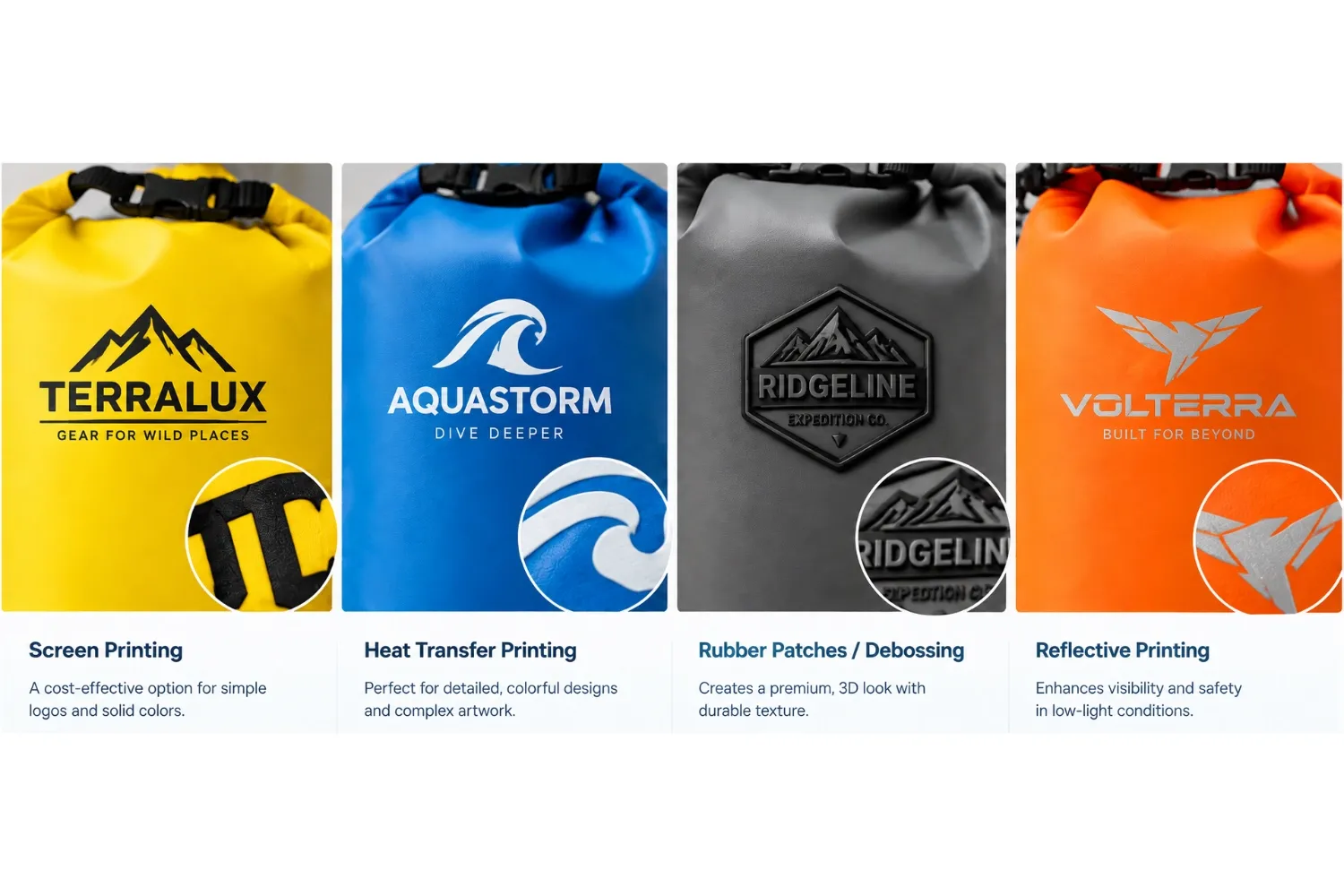
Method 1: Screen Printing
Screen printing is commonly used for logos with relatively simple artwork, such as brand names, symbols, and designs with a limited number of solid colors.
Potential advantages:
- Suitable for simple, clearly defined logos
- Can work well for repeat production
- Allows brand colors to be reproduced within the capabilities of the selected ink and material
Things to consider:
- Each additional print color may increase setup requirements and cost.
- Fine details and small text need to be checked for print clarity.
- Ink adhesion and durability should be evaluated on the actual bag material.
Best suited for: Brands ordering dry bags with straightforward logos, especially when the design is consistent across a product range.
Method 2: Heat Transfer Printing
Heat transfer printing applies a design to the bag using heat and pressure. Depending on the transfer system, it can accommodate more detailed graphics and multiple colors.
Potential advantages:
- Can support more complex artwork than some simple screen-printing setups
- Useful for designs that require several colors or fine details
- Offers flexibility for selected custom branding projects
Things to consider:
- The transfer must be compatible with the bag's PVC, TPU, coating, and surface finish.
- Heat and pressure need to be controlled to avoid damaging the material.
- Adhesion, flexibility, and durability should be tested under the expected conditions of use.
Best suited for: Suitable projects requiring detailed or multicolor branding, subject to material and process testing.
Method 3: Rubber Patches and Debossed Details
Rubber or molded patches can create a distinctive, dimensional brand mark. Depending on the patch design and manufacturing process, debossed or raised details may also be possible.
Potential advantages:
- Creates a textured, three-dimensional appearance
- Can give a product a more technical or premium look
- May suit brands seeking a recognizable visual identity across multiple products
Things to consider:
- Patch material, size, color, and attachment method affect the final appearance and cost.
- The attachment method must be compatible with the bag's material and waterproof construction.
- Stitching may create needle holes, so it should not be assumed to preserve waterproof performance without appropriate design measures and testing.
Best suited for: Outdoor brands that want a more distinctive logo treatment on selected dry bags or waterproof gear bags.
Method 4: Reflective Logo Printing
Reflective logo applications can improve visibility when illuminated, depending on the reflective material and application method.
Potential advantages:
- Adds a functional visual detail
- Can complement products designed for outdoor or low-light environments
- Offers an alternative to conventional non-reflective branding
Things to consider:
- Reflective materials and adhesives must be compatible with the bag surface.
- The logo's visibility depends on the material, lighting conditions, and design.
- Reflective application should not be presented as a safety certification or guarantee of visibility.
Best suited for: Selected outdoor, cycling, paddling, and other products where reflective details are part of the design brief.
3. How to Choose the Best Logo Application
Use the following comparison as an initial guide. The final recommendation should be confirmed against your artwork, material, and product requirements.
Logo method | Suitable design | Main consideration |
|---|---|---|
Screen printing | Simple logos and limited-color artwork | Ink adhesion and print clarity |
Heat transfer | Selected detailed or multicolor designs | Material compatibility and heat resistance |
Rubber patch or molded detail | Dimensional, textured branding | Attachment method and waterproof construction |
Reflective application | Logos requiring a reflective effect | Reflective material and adhesion performance |
Before mass production, ask your supplier to confirm which method is suitable for the selected material and whether a physical sample is recommended.
4. Plan Your Logo Size, Color, and Placement
A well-designed logo should be easy to recognize without interfering with the bag's function.
Logo Placement
Common placement options include the front panel, upper front area, or another flat area suitable for the selected design.
When planning placement, consider:
- The usable print area on the selected bag size
- The roll-top closure and folding area
- Seams, welded panels, pockets, valves, and other functional features
- The visibility of the logo when the bag is carried or displayed
- Whether the same artwork will be used across several bag sizes
Ask your supplier to confirm the printable area for each style. A placement that works on a 20L dry bag may not look the same on a smaller model.
Logo Colors
For simple brand marks, one-color printing may be a practical starting point. Multicolor designs may require additional production steps, depending on the selected printing method.
If you need a specific bag fabric color, ask whether it is available as a standard stock color or requires a custom color order. Fabric availability, order quantity, and color-matching requirements can affect cost and lead time.
For the most consistent result, provide your brand color references and approve the final appearance before mass production.
Prepare Your Artwork
To help your supplier evaluate the design, prepare:
- A vector logo file, preferably AI, EPS, or editable PDF
- The required logo colors or Pantone references, where applicable
- Your preferred logo size and placement
- Any special requirements for reflective details, patches, or multicolor artwork
If you only have a raster image, provide the highest-resolution version available and ask whether it is suitable for production.
5. Consider MOQ, Sampling, and Production Cost
The total cost of custom logo dry bags depends on more than the printing method.
Key factors may include:
- Bag style and capacity
- PVC, TPU, or another selected material
- Material thickness and construction requirements
- Logo method, number of colors, and artwork complexity
- Custom fabric colors and additional components
- Order quantity and packaging requirements
- Sample development, testing, and shipping
Minimum order quantity (MOQ) varies by product style, material, customization method, and factory requirements. Ask your supplier for a quotation based on your actual specifications rather than assuming that every design has the same MOQ.
Why Request a Sample?
A pre-production sample can help you evaluate the bag's appearance, logo size, color, material feel, and overall construction before approving a larger order.
For waterproof products, clarify which performance checks are included in the sample evaluation and what level of water resistance the finished product is expected to achieve. Do not assume that a printed logo or a visually sealed seam automatically guarantees a particular waterproof rating.
Once the design, material, logo application, and specifications have been approved, the supplier can confirm the production schedule and quality-control requirements.
6. What to Look for in an OEM Dry Bag Manufacturer
Choosing the right manufacturing partner is an important part of developing a custom waterproof bag.
When evaluating an OEM/ODM supplier, consider the following:
- Product experience: Does the supplier have experience with the dry bag style and construction you need?
- Material knowledge: Can the supplier explain the differences between available materials and their applications?
- Logo compatibility: Can the supplier recommend a suitable branding method for your design and material?
- Waterproof construction: Can the supplier explain how the bag's seams, closure, and other components are designed?
- Sample and approval process: Can you review the product and logo application before mass production?
- Clear quotation: Does the quotation specify the bag, material, logo method, order quantity, packaging, and shipping terms?
For waterproof bags made with high-frequency (HF) welding, the panel construction and welding process are also important considerations. The finished product's performance depends on the complete design and manufacturing process, not simply on the presence of welded seams.
A clear specification and approval process helps both sides reduce misunderstandings before production begins.
7. Start Your Custom Dry Bag Project with CarryEase
CarryEase supports B2B customers exploring OEM/ODM waterproof bags for outdoor activities, water sports, retail, and promotional projects.
Depending on the project, customization options may include:
- Dry bag styles and capacities
- PVC tarpaulin or TPU material options
- Logo application and placement
- Available fabric colors and selected components
- Individual packaging and other packaging requirements
To help us assess your project, please share your preferred bag style, target capacity, logo artwork, estimated order quantity, and destination market.
We can then review your requirements and discuss suitable material, branding, sampling, and quotation options.
Looking for a custom dry bag supplier for your brand?
Contact CarryEase to discuss your OEM/ODM waterproof bag requirements.
CarryEase Outdoors — Smart Gear Bag Specialist.